Pages

Subscribe:

Ads 468x60px

Featured Posts

Wednesday, 20 April 2016

Every single thing that is wrong with Batman v Superman: Dawn of Justice

Like a big, wet glob of fetid bird droppings tumbling down from the sky, Batman v Superman: Dawn of Justice has landed with an audible splat. It’s been almost three years since director Zack Snyder revealed the project at San Diego Comic-Con and in those years, the multimillion-dollar hype machine has been slowed only periodically by rumblings that something was amiss with the film. Amid splashy trailer releases and return trips to Comic-Con there’s been a steady drumbeat of skepticism in the background. How bad could it be? Well, it turns out, pretty bad.


Where does Batman v Superman's mauling leave Warner's plan for a DC comics cinematic universe?

Despite the 30% Rotten Tomatoes score, you probably rushed out and gobbled up this picture with the reckless abandon of DJ Khaled confronted with a horse trough full of fried chicken. You – the hypothetical reader whom I am very certain is terribly attractive, very intelligent, and wise beyond your years – probably want someone to explain what it is you just witnessed. I would like to offer up my expertise free of charge so that you might better understand the many layers of this motion picture event. I warn you now that this is a spoiler-heavy article, so if you haven’t seen the film and want to remain untainted, please click away immediately. I won’t mind. I mean, you’ve already clicked on it anyway, so cha-ching.

***


The film opens with one of many dream sequences. Let me just say here early that Batman v Superman is mostly dream sequences, and those scenes that are not dreams still seem to function as though the basic laws of reality do not exist. Granted, this is a film about an alien and an alcoholic billionaire pervert throwing each other around in the rain while grimacing heavily. I should probably cut it some slack.
Advertisement

Anyway, Bruce Wayne dreams about his parents being gunned down in front of a movie theater. This is intercut with Bruce Wayne tumbling down a hole where he discovers a massive gathering of bats in a cave. These bats swarm around him, magically lifting him up and out of the hole while he strikes a Christ pose. In other words, we are off to a smashing start. After that, we witness Metropolis being wiped out by Superman and General Zod from the last movie. Superman destroys one of Bruce Wayne’s buildings by accident, which makes Wayne hate Superman. This is an important plot point. You see, Batman only approves of the destruction of private property when he’s the one doing the destroying. Later in the film, Batman tears through the city in his own personal tank, blows up some cars, shoots up a building with his Batwing, kills numerous anonymous henchmen, and lures a dangerous mutant back to a populated area without a coherent plan to defeat it. But he’s not an alien, so it’s OK. I should also mention that Bruce Wayne has a second dream about his dead parents in which blood pours out of his mother’s tomb, then explodes to reveal a demon inside of it. I think maybe he has some unresolved issues.

Bruce Wayne is not alone in hating Superman. The United States government is none too pleased with the last son of Krypton leveling large parts of a major city. Lex Luthor, a wealthy businessman and scientist, also hates Superman. Now, you probably couldn’t quite figure out why Lex Luthor hated Superman so much. Unlike Batman, he has no clear professional jealousy. In fact, in a brief aside, Luthor mentions the construction projects his company undertook after Superman wrecked Metropolis. If he had just kept his mouth shut and let Superman topple a few more buildings, he could have kept raking in the government contracts for decades to come. Instead, he spends most of the movie trying to get Batman and Superman to fight, then creates a monster in a pool of brown toilet water for no reason. I thought this guy was some kinda genius? It doesn’t make sense at first, but upon second viewing, it’s clear that Lex Luthor is actually a malfunctioning android and his moronic behavior is due to his circuits being fried. Every bizarre character choice can be chalked up to what I like to call the “Android Defense”. Something happened in Batman v Superman that doesn’t make any sense? It was probably done by a secretly malfunctioning robot.

Sorry, got a bit off track here. Batman has another dream, where Superman has become a fascist dictator with his own army of stormtroopers. Batman is a lone freedom fighter rebelling against Superman’s iron rule. At the end of the dream, Superman punches a hole in Batman’s chest. Batman wakes up and sees The Flash (not identified as such, I just know because I’m a nerd) inside a time vortex. Flash explains some important plot points for another movie, then disappears. Why is The Flash invading Batman’s dreams? Why did he travel back in time? He’s got to juggle a lot of balls and he only has one butler to handle all of his affairs. He’s not a huge note-taker and doesn’t maintain an iCal. Things slip through the cracks. That’s why he sent The Flash back in time in the first place, like a really elaborate Post-It note. Unfortunately, if Batman had never forgotten about his dream, he never would have sent back The Flash to remind him about the dream, which creates a major paradox, which I don’t want to get into right now.

I haven’t even mentioned Wonder Woman, AKA Diana Prince, warrior princess of Themyscira. Wonder Woman periodically shows up at parties to annoy Bruce Wayne. She steals some computer files from Lex Luthor during a fundraiser for a library or something. Then, Bruce and Diana meet at a totally different party where they stare at a dagger in a glass case. You may have wondered whose party that was, why either of the characters were at that party, and what the point of the knife in the box was. Look, cool people get invited to parties all the time that you don’t know about. You should be used to this by now. Stop asking. It makes you look desperate.

Bruce Wayne opens up Lex Luthor’s computer files and discovers a photo of Wonder Woman from the first world war, plus some trailers for other Warner Bros movies. Luthor even designed logos for all of these movies in Adobe Illustrator. Why does Lex Luthor have four blatant bits of product placement on his computer? Because he’s been maintaining a secret double life as a film publicist. You thought running a multinational corporation while trying to murder an indestructible flying alien was hard? Try selling the Aquaman movie.
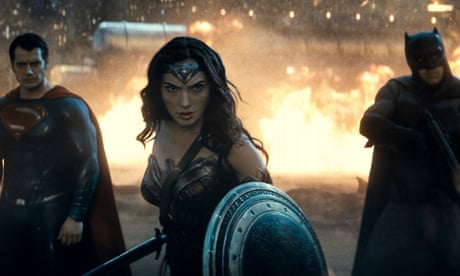


Pow! This isn't Batman v Superman. Whack! It's Wonder Woman v Supersexism

Back to Superman, he’s quite depressed over the mixed reaction to his theatrical heroics, and I don’t mean the reviews for Man of Steel either. Some worship him for his daring deeds, while others are terrified of the unchecked power he wields. Using that divided public opinion against him, Lex Luthor attempts to frame Superman for a variety of very un-Superman activities – shooting up a village, neglecting to stop a suicide bomber, and drinking red wine with seafood. Of course, Superman would do none of these things, but that doesn’t stop the public from turning on him, playing directly into Luthor’s hands.

Dejected, Superman flies off to Buffalo, New York, or some other desolate, snow-covered landscape. There, we are treated to yet another dream sequence. This time, Clark Kent imagines seeing his father throwing bricks on to a pile of other bricks while telling a story about inadvertently ruining the lives of his neighbors during a flood. At this point, you may have asked yourself why Superman flew out to this barren wasteland. You may have also asked what that pile of rocks was? Maybe you thought it was the place where Clark Kent’s dad is buried, but I’m fairly certain it’s been established that he was buried on the Kent farm. So why the hell is Superman having visions of his dead dad in the middle of nowhere? As with everything, there is a simple answer. Nothing reminds me more of Kevin Costner’s acting than a pile of rocks, bricks and twigs in the snow. So, it’s natural that when one sees a pile of inanimate objects, one would pause to consider Kevin Costner. This movie makes perfect sense.


Considering the title of the film, Batman and Superman fight toward the end of the story. It’s as brutal and ruthless as it is boring, with the fisticuffs coming to an abrupt end when Batman realizes that his mom and Superman’s mom have the same first name. If only Biggie and Tupac’s moms had the same first name. They might still be here today.

Lex Luthor’s monster, Doomsday, is unleashed and Batman, Superman and Wonder Woman join forces to defeat him. Why did Lex Luthor create a monster he couldn’t control when he easily could have just shot Superman with a kryptonite rocket 30 minutes into the movie? Why did he waste all of that time convincing Batman and Superman to fight if he was just going to create Doomsday? What if Batman killed Superman? Would Lex Luthor still have a need for a rampaging, uncontrollable beast?

At the end of the film, Superman sacrifices himself to defeat Doomsday, leaving Batman and Wonder Woman to form the Justice League in his absence. Lex Luthor has gone crazy (because he is a malfunctioning android) and has had his head shaved because long hair is strictly forbidden in solitary confinement, as everyone knows. He could have hidden a knife or a grenade in that moptop. Batman mourns his friend, who he had been pals with for a grand total of a couple hours and had previously been single-mindedly obsessed with murdering. Why was Batman so broken up about the death of a man he had spent two years despising? Because, as a great man (me) once said (right now, for the first time), the greatest friendships are the ones that burn out the quickest. If you learn anything from this movie, it should be that. If I were Warner Bros, I’d be throwing that brilliant aphorism on a T-shirt right now.

Kevin Costner's Draft Day may set record for most improbable plot

Remember the thrill you got when 83-year-old Rocky Balboa fought for the heavyweight title in Rocky VI? Or when that receiver pulled out a pistol shot three defenders while scoring a touchdown in The Last Boy Scout? Or when hard-luck golf pro Kevin Costner holed a 235-yard shot in Tin Cup?

That stuff would never happen in real life unless Aaron Hernandez was trying to score, but it makes for better movies. I bring this up because Costner's latest sports foray may have just set a record for implausibility.
Ladies and gentlemen, we give you Draft Day. I don't want to say you need the sports IQ of a nacho to enjoy the Cleveland Browns drama, but consider some of the plot points (obligatory spoiler alert here):

• The new head coach arrived from Dallas, where he'd just won a Super Bowl. No, the movie is not set in 1994.

• Costner, the general manager, trades three future No. 1 picks for the top pick in the 2014 draft. He gets his player then bluffs Seattle into trading back the three No. 1 picks and a punt returner.

• After getting the top pick, Cleveland's GM realizes he didn't scout the best player in the draft, a quarterback from Wisconsin. OK, maybe that one's not so implausible.

• Just before the draft, the Browns' hot, young salary-cap expert tells Costner she's pregnant with his baby. (Note: most NFL capologists do not have affairs with general managers, no matter how good they look in lingerie).

• Costner's mother shows up with the urn containing the ashes of his father and demands to spread the ashes over the practice field. A bunch of dead Hall of Famers come out a corn field at the end and play catch with the urn.

Wait, that was Field of Dreams. Even hardcore baseball fans still get weepy over that one.

Draft Day won't become a classic, but you might still find it enjoyable if you observe the first rule of sports movie viewing:

Check your brain at the theater door, especially when Rocky VII comes out in 2023.

Wonderlich watch

Speaking of Cleveland blowing picks, draft hype entered its Wonderlich phase last week with the unauthorized release of certain players' scores.

I don't want to say the NFL is manipulating the media to keep people talking about the draft, but it is and it's working. The mock draft world was rattled with the news that Johnny Manziel has the highest score among quarterbacks at 32.

The Wonderlich scale goes from 50 (Einstein) to 0 (insert Mississippi State joke here). It's fun to talk about, but if it had any bearing on pro careers Ryan Leaf (27) would be in the Hall of Fame and Dan Marino (15) would be selling insurance. Other scores of interest over the years:
Tim Tebow (22), Peyton Manning (28), Eli Manning (39), Percy Harvin (12), Sebastian Janikowski (9), Chris Leak (8).

Blaine Gabbert had 42, roughly the same number of interceptions he threw per season with the Jaguars.

Reason No. 8,492 the Masters is a tradition unlike any other

U.S. ski star Bode Miller was prevented from taking a quesadilla onto the course during the first round. Security stopped Miller as he was leaving a hoity-toity hospitality.

"If you pay $7,500, you ought to be able to bring out a quesadilla," Miller said.

Despite calls from the New York Times for Augusta National to stop menu discrimination, Masters chairman Billy Payne said the club will not be pressured into offering memberships to minority food groups.

Speaking of food groups, John Daly was again hawking merchandise outside Augusta National's gates this year. Daly told The Guardian that since undergoing lap band surgery in 2009, he's down from 28 to a dozen or so Diet Cokes a day. He is up to 40 cigarettes a day. His Wonderlich score is holding steady at 6.

Reason No. 8,493 the Masters is a tradition unlike any other

For $7,500, Miller could have gone to the concession stand and bought 2,000 pimento cheese sandwiches, 1,200 beers and 900 moon pies.

Game of Thrones

Friday, 11 December 2015

Looking back at Kevin Costner's The Postman

vin Costner's epic adventure The Postman was released in 1997 to a mixed reception. Here, Michael Reed argues that still it has a lot going for it…

"When bad men combine, the good must associate; else they will fall one by one, an unpitied sacrifice in a contemptible struggle." Edmund Burke

The Postman is a post-apocalyptic adventure based on the David Brin novel of the same name. Director and star Kevin Costner delivered a film of epic proportions, both in terms of storytelling and its hefty 178-minute running time.

Although an ambitious and heartfelt effort, the film received negative reviews, and did woeful business at the box office. You can summarise reviewers' negative assessment in one word: overindulgence. In deference to those critics, it does feature periodic descents into over-sentimentality, an obese approach to the cutting of scenes and dialogue that often clunks.


However, I contend that if viewed as a movie with a few flaws, it has much to offer. In fact, it may even be overlooked as one of the best entries in the post-apocalyptic film canon.

Background


Given the high-profile supposed failure of Waterworld (1995), his previous post-apocalyptic venture, it might seem surprising that Costner was allowed to embark on this project. However, a more detailed evaluation makes sense of the situation.

Firstly, despite its notoriety, Waterworld wasn't actually a financial disaster. Although it didn't immediately make back its massive $175m budget domestically, it did turn a healthy profit when worldwide ticket and home video sales were taken in to account.

Secondly, Costner was still on a career high at that point. His resumé was chock full of solid performances in films such as The Untouchables, Robin Hood: Prince Of Thieves and Oliver Stone's JFK. In addition, he was still mainly known as Kevin ‘Dances With Wolves' Costner, the Oscar-winning director. Despite the relative disappointment of Waterworld, a Costner-helmed action movie must have seemed like a good bet.

The Book

"The Postman was written as an answer to all those post-apocalyptic books and films that seem to revel in the idea of civilization's fall." David Brin

The Postman is loosely based on the book of the same name, and like all adaptations, the filmmakers were faced with choices over the content. In a nutshell, the film is a somewhat different adventure featuring the same character, setting and premise.

Although a great read, the source novel has some problems of its own. Originally, it comprised three short novels that were later collated into a longer book in three parts. Part one is a highly entertaining story that follows the adventures of the main character as he journeys across the remnants of a disaster-ravaged North America.

Part two follows on from this, and details his contact with a technological civilisation that aspires to reform and reclaim the wasteland.

Part three is where the story takes a somewhat different tack, with a jarring transition into the realms science fiction rather than the speculative fiction of the first two parts. It's as though the author took every suggestion he had been given and tried to cram it in into the final part.

The Film

"Instinctively realizing that the tale ought to be about decency, heroism and hope, he threw out all the dismal old drafts and hired Brian Helgeland, esteemed screenwriter of L.A. Confidential." David Brin on Costner
The film adaptation strips out the futuristic elements of the latter parts of the book (genetic engineering, super computers) and grounds the story as a pure survivalist tale that could be considered a neo-western. Preserved is the premise of a scam, involving an old postal uniform, that is so effective that it soon takes on a life of its own.

As the loner who gets caught up in events and eventually comes good, Costner's character is fairly stock. Whether you enjoy his characterisation probably depends on how you feel about Costner. To some, he brings a likeable, intelligent, everyman quality to a heroic role. Others find his delivery corny. The Postman is certainly a classic slice of what Costner does best, in contrast with the unlikable, emotionally dull performances of, say, Viggo Mortensen in The Road (2009) or Denzel Washington in The Book Of Eli (2010).

The reluctant hero might seem like a well-worn movie trapping, but it reflects one of the main themes of the book, one that could be summed up with the saying: "All that is needed for evil to triumph is that good men do nothing." Throughout the book, the main character reflects that his quest is to find someone who is willing to take responsibility for things, and gradually, it dawns upon him that the mantle is his.

The film version of The Postman is, like most good adaptations, streamlined. For one thing, there is a well-defined hero and a definite, singular villain. In this role, Will Patton's General Bethlehem was a point of derision by critics of the time, but I suspect they misunderstood what he was trying to do. He is by turns both frightening and vicious, but there is always the hint of a pathetic Richard III type - a photocopier salesman who became a tyrant when the opportunity arose.

This isn't Darth Vader we're talking about. He's the epitome of a man filled with doubt about his manliness (it is implied that he is sexually impotent) and who compensates with grandiose displays of cruelty and bullying. That his cruelty eventually forces the hero to fight is also an idea lifted from the book.

Technically, the film is excellent, with sumptuous, cleverly composed cinematography and subtle use of CGI compositing. It's clear that no expense was spared in the location work, and this is combined with the liberal use of armies of extras. The visual grandeur can only be described as epic, and the exuberant soundtrack by James Newton Howard is the perfect accompaniment.

The smaller character parts are mostly well played. Rather than the naive but aspirational character in the book, Brit actress Olivia Williams plays Abby as a world-weary foil to the main character, with her comparable intelligence and sense of values. Larenz Tate as Ford gives a sometimes overly earnest performance that in some respects embodies the spirit of the entire film. Costner cast his own daughter in some scenes that threaten to become a bit creepy.

The well-defined hero and villain characters, the streamlined adventure story and Costner's typically upbeat delivery combine to produce a rousing, swashbuckling film, and I think this gives some clues as to why such a well-made film wasn't better received than it was. Back in the 90s, the fashion was for everything to be dark and edgy. Seven epitomises the appetite audiences had for grunge.

The biggest hit of 1997 was about a ship that sank. I suspect that if a yellow and brown tinged misery-fest like The Book Of Eli had turned up in the mid-90s, it would have been a huge success. Conversely, The Postman would probably have done much better if released today.

Criticism


Viewers will quickly spot some unforgivable shortcomings that can't be dismissed as a simple clash with the era's fashion whims. The Postman's reputation as film that plumbs the depths of sentimentality is, at least in part, deserved. Its near three-hour duration must have presented a challenge to distributors and audiences alike. Particularly, at the start of the final third, there are some scenes that could have been excised in order to improve the film. As a result of these extraneous scenes, this is the only stretch of the film that really does begin to drag.

One wonders what influence Costner had on the construction of the final cut. What was needed at this stage of production was the objectivity of a butcher with a sharp knife and a kind heart. There are many scenes, such as one involving a weird cameo by Tom Petty, that must have involved a lot of work at the time of filming, but didn't really work on screen.

We've seen it done before. For example, Richard Donner had a corker of an opening scene for Lethal Weapon involving a bar fight, but he removed it as it wasn't needed. The so-called director's cuts of both Alien and Aliens both contain reams of fascinating extra footage, and yet the directors themselves, and many fans, agree that the slimmer theatrical editions are definitive. Did Costner, I wonder, insist that some of his hero sequences be left intact due to ego?

This isn't to say that The Postman would have been the better film if it were substantially shorter. On the whole, it makes fairly good use of its length to deliver a grandiose story. However, cuts of a few minutes here and there would have improved the film a great deal. On a smaller scale, the blushes of the actors, due to moments of groan-worthy dialogue, could have been spared with some careful snipping within the scenes themselves. "You give out hope like it was candy in your pocket." Ouch.

Although the film is mawkish, this isn't to say that it would have been better if the script had been stripped of sentimentality. It's a film with a lot heart and some genuinely moving moments, for those who are willing to be moved.

Ironically, Costner gave up a starring role in Air Force One, a feel-good, patriotic action movie that did very well financially to make The Postman. Did he make the right decision? Most people who hated Air Force One would criticise it for its blandness, and for better or worse, The Postman is a film with a lot of heart. Despite its faults, it's hard to justify the criticism that it has been subjected to, while films such as the Mad Max series or the more recent spate of zombie apocalypse films don't seem to be judged by the same standards.

It's far from perfect, but if you're willing to overlook its shortcomings, The Postman is a rousing, touching, exciting adventure that has great deal to offer.

Kevin Costner

Costner, Kevin

COSTNER, Kevin


Nationality: American. Born: Compton, near Los Angeles, 18 January 1955. Education: Studied business at the University of California, Fullerton; studied acting at the South Coast Actors Co-op. Family: Married Cindy Silva, 1978 (divorced 1994), three children: Annie, Lily, and Joe. Career: Worked in marketing for six weeks, left and became stage manager at Raleigh Movie Studios; made film debut in small nonunion picture, Stacey's Knights, 1981; was cast in, but edited out of, Lawrence Kasdan's The Big Chill, 1983; set up own production company, TIG, late 1980s; executive producer and narrator of TV series 500 Nations, 1995. Awards: Academy Award for Best Director, Directors Guild of America Award for Outstanding Directorial Achievement in Motion Pictures, Silver Bear Award, Berlin Film Festival, Golden Globe Award for Best Director, National Board of Review NBR Award for Best Director, and PGA Golden Laurel Award as Motion Picture Producer of the Year, all for Dances with Wolves, 1990. Office: TIG Productions, 4000 Warner Blvd., Burbank, CA 91523.

Films as Actor:

1981
Stacey's Knights (Winning Steak) (Wilson) (as Will Bonner); Shadows Run Black (Heard) (as Jimmy Scott); Chasing Dreams (Roche and Conte) (as Ed)
1982
Frances (Clifford) (as Man in Alley); Night Shift (Ron Howard) (as Frat Boy #1)
1983
The Big Chill (Kasdan) (as Alex; scenes deleted); Testament (Littman) (as Phil Pitkin); Table for Five (Lieberman) (as Newlywed Husband)
1984
American Flyers (Badham) (as Marcus Sommers)
1985
Silverado (Kasdan) (as Jake); Fandango (Reynolds) (as Gardner Barnes)
1986
Sizzle Beach U.S.A. (Malibu Hot Summer) (Brander—produced in 1974) (as John Logan)
1987
The Untouchables (De Palma) (as Eliot Ness); No Way Out (Donaldson) (as Lt. Cmdr. Tom Farrell)
1988
Bull Durham (Shelton) (as Crash Davis)
1989
Field of Dreams (Robinson) (as Ray Kinsella); The Gunrunner (Castillo—produced in 1983) (as Ted Beaubien)
1990
Revenge (Scott) (as Cochran, + co-pr)
1991
Robin Hood: Prince of Thieves (Reynolds) (title ro, + co-pr); JFK (Stone) (as Jim Garrison); Truth or Dare (Keshishian—doc) (as Himself)
1992
The Bodyguard (Jackson) (as Frank Farmer, + co-pr); Beyond 'JFK': A Question of Conspiracy (Kopple, Schechter—doc) (as Interviewee); John Barry-Moviola (Brien—doc) (as Himself)
1993
A Perfect World (Eastwood) (as Butch Haynes)
1994
The War (Avnet) (as Stephen); Wyatt Earp (Kasdan) (title role, + pr)
1995
Waterworld (Reynolds) (as the Mariner, + co-pr)
1996
Tin Cup (Shelton) (as Roy "Tin Cup" McAvoy)
1999
Message in a Bottle (Mandoki) (as Garret Blake); For Love of the Game (Raimi) (as Billy Chapel)
2000
Play It to the Bone (Shelton) (cameo appearance); Thirteen Days (Donaldson) (as Kenny O'Donnell); 3,000 Miles to Graceland (Lichtenstein)
2001
Beyond Borders (Stone)

Films as Director:

1990
Dances with Wolves (+ pr, ro)
1997
The Postman (+ ro)

Films as Producer:

1993
Rapa Nui (Reynolds)
1996
Head Above Water (Wilson) (co-pr)

Publications

By COSTNER: book—

Dances with Wolves: The Illustrated Story of the Epic Film, with Michael Blake and Jim Wilson, New York, 1990.

By COSTNER: articles—

Biskind, Peter, "Kevin Costner: The Untouchables' New Ness," in American Film (Hollywood), vol. 12, no. 8, 1987.
Interview in Time Out (London), 6 January 1988.
Andrew, Geoff, "Indian Bravery," interview in Time Out (London), 9 January 1991.
Winnert, Derek, "Untouchable Costner," interview in Radio Times (London), 2 February 1991.
Case, Brian, "The Men Who Shot J.F.K.," interview in Time Out (London), 8 January 1992.
Charity, Tom, "Hell and High Water," interview in Time Out (London), 26 July 1995.
Graham, Alison, "Will Costner Sink or Swim?" interview in Radio Times (London), 12 August 1995.

On COSTNER: books—

Hamilton, Sue L., Kevin Costner: Award-Winning Actor/Director, Edina, Minnesota, 1991.
Keith, Todd, Kevin Costner: The Unauthorized Biography, London, 1991.
Wright, Adrian, Kevin Costner: A Life on Film, London, 1992.
Caddies, Kelvin, Kevin Costner: Prince of Hollywood, 1994.
Edelman, Rob, Great Baseball Films, New York, 1994.
Fournier, Roland, Kevin Costner, Monaco, 1995.

On COSTNER: articles—

McGillivray, David, "Kevin Costner," in Films and Filming (Lon-don), July 1987.
"Pursuing the Dream," in Time (New York), 26 August 1989.
Current Biography 1990, New York, 1990.
Morais, R. C., "Kevin Costner Journeys to a New Frontier," in New York Times, 4 November 1990.
Schruers, Fred, "Kevin Costner," in Rolling Stone (New York), 29 November 1990.
Hubler, Eric, "The Way You Were," in Premiere (New York), January 1991.
Deitch, Mark, "Kevin Costner: Screen of Dreams," in National Film Theatre Booklet (London), February 1991.
Pearce, Garth, "Robin Hood: Prince of Thieves," in Empire (Lon-don), August 1991.
Mills, Bart, "Kevin Costner: A Modest Superstar," in Saturday Evening Post, September/October 1991.
Klein, Edward, "Costner in Control," in Vanity Fair (New York), January 1992.
Janos, Leo, "Kevin Costner: The Prince Who Would Be King (of Hollywood)," in Cosmopolitan (New York), March 1992.
Weinraub, Bernard, "The Name Costner Acquires a Question Mark," in New York Times, 21 February 1995.
Bellafante, G., "Broken Peace," in Time (New York), 31 July 1995.
Brown, C., "Water Torture," in Premiere (New York), August 95.
Vollers, M., "Costner's Last Stand," in Esquire (New York), June 1996.
Millea, Holly, "Imperfect World," in Premiere (New York), Janu-ary 1998.
Angell, Roger, "Kevin Costner Takes the Mound at Yankee Sta-dium," in New Yorker, 7–14 December 1998.
* * *
At the beginning of his career, Kevin Costner spent several years knocking around the edges of the film industry. Some of his roles were so small that his presence was barely noticed. Others were bigger parts in dreadful low-budget potboilers that later came back to haunt him when they ingloriously appeared in video stores. He caught the attention of critics and audiences with his scene-stealing, star-making supporting performance as Jake, a roguish gunslinging cowboy, in the Lawrence Kasdan Western Silverado. The plum role was a payback of sorts from Kasdan; Costner earlier had played Alex, whose suicide sparks the chain of events which unfolds in The Big Chill, but the director decided to cut the character from the film's final edit. All that remains of Costner in The Big Chill are his feet in the opening sequence, as Alex is being prepared for his funeral. Costner similarly had been cut from Frances, a biography of Frances Farmer, appearing on-screen ever so briefly in a scene in an alley in which he has one line.

Costner was to solidify his stardom playing square-jawed, true-blue all-American heroes. He specialized in such character types early on, playing Eliot Ness in The Untouchables, a remake of the classic television series, and a stalwart naval officer who uncovers corruption in No Way Out. Both these characters are generic Hollywood good guys who remain uncorrupted as they take on the scenario's villains. Around this time, Costner expressed his desire to be linked to the Frank Capra-Jimmy Stewart tradition, playing boyish and stable leads, and he did just that in the baseball films Bull Durham and Field of Dreams. In the former, he is aging catcher Crash Davis, a ballyard purist who understands and loves the game, but whose limited talent has kept him in the minor leagues for most of his career, with only brief appearances in "The Show." In the latter, by far his most Capraesque film, he is Ray Kinsella, a Midwest farmer who is told by a divine voice to replace his corn stalks with a baseball field. Both these heroes are in the classic Hollywood tradition. In an earlier era, each might have been played by Stewart; indeed, during its publicity tour, Costner touted Field of Dreams as "our generation's It's a Wonderful Life." Furthermore, Costner's Jim Garrison in JFK may lack the outright innocence of Stewart's Jefferson Smith in Mr. Smith Goes to Washington, but they remain linked in their idealism and vigor. As Costner orates in court on how the facts of the assassination of President John F. Kennedy have been concealed from the American public, he becomes reminiscent of Stewart filibustering on the Senate floor and exposing venal Washington politicians.

Nevertheless, the appealing boyishness of Costner's characters was not always Capraesque. It may be in Field of Dreams, where Ray Kinsella's true-blue idealism becomes one of the scenario's overriding factors. But in Silverado, that innocence is portrayed as outright immaturity, as his character acts recklessly (and easily might have come to be known as "Jake the Kid"). At the same time, Costner has more than adequately played the contemporary male sex symbol. His characters are anything but boyish when tangling with their female counterparts. In No Way Out, he and Sean Young share a headline-making rendezvous in the back seat of a limousine, and his between-the-sheets antics with Susan Sarandon in Bull Durham are no less erotically charged.

Costner's heroes also are contemporary in that they are alienated souls who occasionally take on subversive edges. His Lt. John Dunbar, the Civil War soldier in Dances with Wolves, is anything but the traditional American Western hero in that he is as deeply troubled as highly principled, and he goes on to renounce western civilization and join (rather than fight) a Lakota Sioux Indian tribe.
Overall, in the first section of his career, Costner embodied the traditional Hollywood hero. The actors surrounding him may be cast in the juicier and more colorful roles: Robert De Niro and Sean Connery in The Untouchables; Gene Hackman in No Way Out; Tim Robbins in Bull Durham; Graham Greene and Rodney A. Grant in Dances with Wolves; and, later on, Alan Rickman and Morgan Freeman in Robin Hood: Prince of Thieves. But Costner's presence in each film is essential, as it serves as a consistent calming and stabilizing force at the scenario's center.

Dances with Wolves is to date the summit of Costner's career, if only because he directed as well as starred in the film—and won Oscars for Best Picture and Best Director. As a film, it is deeply flawed. With the exception of Dunbar, the whites all are depicted as grungy, crazy, sadistic, or (in the case of the Civil War general who travels with his own personal surgeon) products of a class system.
Meanwhile, the Lakota Sioux are, to a person, attractive, squeaky-clean models of reason. Dances with Wolves is almost laughable in its superficial political correctness. And why so much graphic, stomach-churning violence? Perhaps Costner was trying to contrast the harsh reality of life on the American frontier with its breathtaking natural beauty. This could have been accomplished in one poignant, cleverly directed sequence. In Dances with Wolves, there is a distasteful overdose of blood and pain.

Costner slipped somewhat in his immediate post-Dances with Wolves career, in that he was unable to find an interesting role in a commercially successful film. By far his two best mid-1990s parts came in A Perfect World and The War. In each, he plays a character with a deeply troubled past who attempts to be a positive role model to children. Costner may have given an excellent performance—arguably the best of his career—in A Perfect World, playing Butch Haynes, a sympathetic prison escapee who takes a young boy hostage. The film's director, Clint Eastwood, has the standard hero role, that of the Texas Ranger who sets out on Haynes's trail. But audiences rejected Costner in A Perfect World, and the film was a financial failure. He also is fine in The War, playing an unstable but well-intentioned Vietnam veteran. Moviegoers did not flock to see the film, however, preferring him instead in The Bodyguard, in which he stars as an icy-cold professional bodyguard who falls for the superstar singer he has been hired to protect. Aside from its wide popularity, The Bodyguard is an overripe exercise in Hollywood corn.

In spite of the prominence of his role in JFK, that film is a star vehicle for its director, Oliver Stone, rather than any of the actors in its cast. Robin Hood: Prince of Thieves (despite a delightfully campy performance from Alan Rickman as the Sheriff of Nottingham) pales in comparison to similar films of an earlier era; the same might be said for Wyatt Earp, featuring Costner in the title role, in which he is reteamed with Silverado director Kasdan.

In Waterworld, Costner attempted to enter Stallone-Schwarzenegger territory as a cartoon hero in a special effects-laden action movie extravaganza. But the film will be remembered not for its entertainment value but for the reams of negative publicity it earned as the costliest movie made to date. While not the fiasco of a Heaven's Gate or Ishtar, Waterworld did nothing to enhance Costner's career. Yet the film was the equal of Star Wars when contrasted to his career nadir: The Postman, a laughably ludicrous post-apocalyptic allegory that was a critically skewered box office disaster.
Costner directed as well as starred, playing a drifter-loner who impersonates a postman and becomes the savior of a war-ravaged populace.

If he is to remain a bankable movie personality, Costner would be advised to seek out roles that are aging versions of the ones that firmed up his stardom. This is precisely what he did in two of his late 1990s releases, both reminiscent of Bull Durham and Field of Dreams in that their scenarios reflect on sports as a metaphor for life. The first is Tin Cup, in which he was reunited with Bull Durham director Ron Shelton. Costner exudes charm as a broken-down golf pro who operates a dinky driving range and sets out to qualify for the United States Open, but is done in by his lack of discipline and obsession with hitting the perfect golf ball. Adding to his appeal is his romantic pairing and verbal sparring with a talented and attractive co-star, Rene Russo. In For Love of the Game, the final installment in what may be considered Costner's baseball trilogy, the actor plays an aging Detroit Tigers pitcher and future Hall of Famer who hurls a perfect game in Yankee Stadium. While not in the same league as Bull Durham and Field of Dreams, For Love of the Game is a fine companion piece that is a knowing story of baseball and baseball psychology, of team effort, time passing, and bonds between fathers and sons. Off the field, when the scenario spotlights Costner's character and his girlfriend, played by Kelly Preston, the film works as a love story featuring fully fleshed-out characters in a believable relationship.

In between Tin Cup and For Love of the Game, Costner faltered in the less-successful Message in a Bottle, a contrived tearjerker casting him as a grieving widower who tentatively becomes involved in a new romantic relationship. So in addition to finding good roles, he also must look for good scripts.

Draft Day

Why did the NFL—America’s most obsessively image-conscious sports league—allow this catastrophe to happen?

Kevin Costner in Draft Day
Courtesy of Dale Robinette/Summit Entertainment

When you finish seeing a movie like Draft Day—the NFL’s current foray into what might be called failed experimental cinema—you ask yourself a lot of questions, most of which start with why. Why did I just watch this? Why did people think to make this, and why didn’t other people stop them?
Draft Day is one of the dumbest movies about sports ever made because it’s one of the dumbest ideas for a movie about sports that anyone has ever had, a fictional film about pro football that isn’t even actually about football. And yet it’s a movie in which National Football League commissioner and designated shield-protector Roger Goodell appears on screen, as himself, several times; he’s even memorized lines. Why did the NFL—America’s most obsessively messaged and image-conscious sports league—allow this catastrophe to happen?

I’ll try to recount the plot of Draft Day without “spoiling” the movie, which, trust me, is a hilarious thing to write. Kevin Costner plays Sonny Weaver Jr., embattled general manager of the Cleveland Browns. (Side note: Can we declare a moratorium on sports-related entertainments made at the expense of Cleveland teams? Clevelanders are good people who’ve suffered enough.) Early in the movie Sonny Weaver Jr. acquires the first pick in the NFL draft via a trade on the morning of the draft itself. Sonny Weaver Jr. spends the rest of the film trying to decide what to do with the pick. At the end of the movie he does something with it, and also learns about the importance of family, wouldn’t you know—the film’s script treats the “Jr.” at the end of a character’s name like it’s Chekhov’s gun.

And that’s pretty much it. There are other characters wandering around, but they’re just props. Jennifer Garner plays Weaver’s secret girlfriend, who is secretly pregnant but also super supportive and a salary-cap genius—what a catch! (Draft Day’s gender politics are close to psychotic.) Sean Combs plays an agent, in a performance that pulls off the miraculous feat of making me wish he’d stick to rapping. Frank Langella sleepwalks through the movie as the team’s owner, and I’m not sure that’s a figurative assessment: He wears sunglasses for the entire film. Countless real-life football and media luminaries appear on screen as themselves, because otherwise everything just described wouldn’t be believable.

Draft Day is helmed by veteran director Ivan Reitman (Ghostbusters, Dave), who to his credit seems aggressively disinterested in the material at hand. The “filmmaking” here consists of making sure the camera is pointed at people who are explaining the movie’s plot to one another, preferably while they are wearing logos and standing in front of more logos. “This city deserves a championship, and I’m the guy to deliver it!” declares one character to his co-worker. At one point an assistant refers to “your star wide receiver, Andre Bell” in conversation with Sonny Weaver, seemingly explaining to the GM who a player on his own team is. Normally this would just be a clumsy way of introducing a character, except that “Andre Bell” isn’t even in the film and never comes up again. He exists only to be mentioned, pointlessly.

But at least these howlers are spoken by actors who are actually conversing in person. An absolutely insane amount of Draft Day unfolds over the telephone. To get around this fundamental cinematic flaw, the film employs a gimmicky split-screen device in which characters thousands of miles away from each other appear to stroll in and out of each other’s shots. It’s a lazy and chintzy touch that only highlights the fraudulence of the interactions. But how else are you supposed to make a 110-minute movie about people talking on the phone? Sometimes the most obvious answer is the best one: You don’t.

Draft Day seems wrought from Moneyball, a pretty good film based on a great book that, next to Draft Day, looks like The Rules of the Game. Moneyball garnered box office receipts and award nominations and clearly convinced someone that there’s an appetite for Hollywood entertainments about the office politics of pro sports franchises. But Moneyball is based on things that actually happened. It’s also an intellectual history, a movie about ideas and people who have them. Draft Day, on the other hand, is a proudly anti-intellectual film that worships a world in which real men who hate nerds and love grit and heart and strong jawlines are right. Draft Day is ostensibly a movie about futures—after all, what are draft days if not feasts of speculative optimism—that’s terrified of progress. One of the film’s running “gags” involves an emasculated assistant who wears glasses and uses a computer and as such is subject to constant humiliations.

It says a lot about the forces responsible for Draft Day that this is the only character the film can bring itself to be cruel to. Everyone else starts and ends this movie as a good guy. Sonny Weaver is ambivalent about fatherhood, but that’s only because he cares about football so much, don’t you understand? The mother-to-be of his child does. There’s disagreement between Weaver and his blustery head coach (Denis Leary), but it’s really just a dust-up between two winners who want to win. There’s a quarterback prospect who might not be all he’s cracked up to be, except we never find out, and on second thought, he’s probably fine.

This general lack of conflict is a strange problem for a film to have, and it’s born of the fact that Draft Day isn’t so much a movie as a movielike infomercial for the kinder, gentler NFL. No one in Draft Day can be bad because no one in football can be bad. In the wake of labor strife, off-field scandals, and the ongoing CTE crisis, the NFL is doubling down on its fantasy of paternalism, and Draft Day is that fantasy’s porn film. Here is a vision of sports where rich men in expensive suits and branded apparel always have everyone’s best interests at heart. A middle-aged white man lectures a young (and as-yet-unpaid) black man on the evils of speaking his mind on Twitter, and we’re expected to nod along sagely. Family is everything, and everything is family-friendly: In a behind-the-scenes movie about pro football, the word fuck is uttered once, as a climactic applause line.

The NFL is in an awkward place right now, the most popular kid in school whom everyone’s starting to hate, and the kid knows it. So we’ve ended up with a movie about professional football that can barely bring itself to show the sport but instead exists solely to let us know how swell the people profiting from it are. Draft Day isn’t shield polish so much as a shield itself, and the mere fact that it exists is so desperate and unseemly that it almost makes me sympathetic to Goodell and his bumbling megalith. After all, when all’s said and done, I like football. But I like movies, too, and finally we’ve found our conflict.

'Draft Day': My behind-the-scenes experience with Kevin Costner

Editor's note: NFL Media's Jeff Darlington was one of four national sports reporters to visit the set of "Draft Day" during filming at the Cleveland Browns' training facility last year. He appears briefly in a scene with Kevin Costner near the end of the movie. With the film hitting theaters on April 11, here is a chronicling of Darlington's on-set experience.

BEREA, Ohio -- In his next scene, Kevin Costner had to do something that always leaves him feeling slightly uneasy. He was about to act out some lines on set of his upcoming movie, "Draft Day," but it was going to call for some spontaneity.


"I have to do some improvisation over here now," said Costner, surrounded by cameramen and actors inside the Cleveland Browns' indoor training facility last May. "And it's not really my specialty.

"I'm a little slower. Some people can memorize their scene the night before. I can't do that."

Instead, beginning three weeks before he started filming, Costner did something that might surprise you: He didn't just memorize his own lines -- he memorized everyone else's lines, too.

If there was one aspect of my weekend spent on the set of "Draft Day" that truly impressed me, it was probably Costner's approach. It turns out, making this movie actually had some similarities to the plot of the movie itself.

In the film, Costner assumes the role of Browns general manager, put in a position to make some quick decisions that could alter the direction of the organization. No doubt, that's a reality that will face 32 general managers next month during the real NFL draft.

However, like Costner's groundwork for this movie, the draft is far from a brief engagement. It requires preparing for every possibility. It requires scouting. And rehearsals. And dozens of sleepless nights. Just as Costner planned for weeks to be ready for the moment director Ivan Reitman screamed "action," general managers around the NFL are grinding away in anticipation of the moment Commissioner Roger Goodell officially opens the 2014 NFL Draft.

"Hopefully, we'll make a good movie," Costner said on set, not knowing at the time how the movie would look on the big screen. "We have a good (script). Will we stay the course? Will we get edgy? What will we do? How will it turn out?"

As difficult as it might be for some hardcore football fans to envision a movie starring Costner and Jennifer Garner actually having some NFL draft legitimacy, you might find yourself surprised.

No, I didn't get the sense Costner and Garner completely immersed themselves in the football landscape, like some of the great method actors of our time do for roles. But they did consult many football professionals. They did attempt to maintain the integrity of the NFL draft -- even if it also required some creative license at times.

"We're trying to run a fine line where we don't dumb it down but at the same time we don't lose the audience," Costner said last May. "Sometimes, it might seem a little over-simple in our script, and maybe if we gave it just a little more locker room guy talk. ... I'll try to step that up a little bit.

"But we don't go so deep that we're going to lose somebody. Sometimes, we hit it just right. Sometimes, it might feel a little too simple."

Costner might understand the magic of making a sports movie better than anyone. After all, Costner's previous sports flicks -- like "Field of Dreams," "For Love of the Game" and "Bull Durham" -- have managed to resonate for years. There's no question, as he proved during our on-set conversation, he is a fan of sports with great respect for competition.

"I can tell you stuff that might blow your mind," Costner said. "I remember my brother getting ready to go to Vietnam. I was very young ... 13 years old. We were going to this picnic, but O.J. (Simpson) was going to play (Joe) Namath, and I really wanted to see it. You remember all of those moments.
"The NFL can really mark your life in a lot of ways."


For the casual sports fan, perhaps, there is no reason to think beyond the surface of a sports movie.
But for the hardcore football fan, for those who respect the intricacies and finer details of the sport (like the NFL draft), it is important for a movie like this to come with its share of authenticity. By spending some time with Costner, a man who seemingly takes himself just serious enough, I gained a better understanding of why his sports movies manage to appease the casual and the hardcore.

Like NFL general managers, he put in the work beforehand. But he also left ample room to maneuver when the lights turned on.

"Sports are romantic," Costner said. "You have to be a romantic to make it work."

Kevin Costner's Browns film 'Draft Day' unveils trailer

A trailer has been released for "Draft Day," the new Kevin Costner vehicle about an embattled general manager of the Cleveland Browns tasked with making the right decisions on a hugely important day in franchise history.


Also, Jennifer Garner is involved and she's smart and pretty and challenges Costner's character in ways nobody has in a long time. Probably. The movie is scheduled for release next April.

Parts of "Draft Day" were filmed at the actual 2013 NFL Draft held in New York's Radio City Music Hall. I interviewed the guy who plays the hotshot quarterback. He was pleasant and bared more than a passing resemblance to Blaine Gabbert.

Houston Texans running back Arian Foster, who portrays another top prospect, filmed a red carpet scene hours before the real draft began. He didn't want to talk to me but was cool about it.

The script was co-written by a lifelong Browns fan. You can find out more about the movie here.

One personal anecdote: When I first got to Radio City Music Hall, I ducked into a small office where media members were given credentials. Sitting in that office, getting his photo taken for a fake credential, was actor Frank Langella. He plays the owner of the Browns in the movie. I know him mostly as the heavy in "Dave," but he's an Oscar-nominated actor who's starred in roughly 9,000 movies.

Langella got his picture taken and quietly exited the room. A harried production assistant arrived moments later, looking for Langella for whatever reason. The news, delivered by another member of the crew, was not good.

"Frank's gone."

The PA stared ahead blankly while Frank Langella did whatever Frank Langella does when he slips out onto Manhattan's 6th Avenue on a late-April afternoon.

"Draft Day" still was going. But Frank's day was done.
 
Blogger Templates